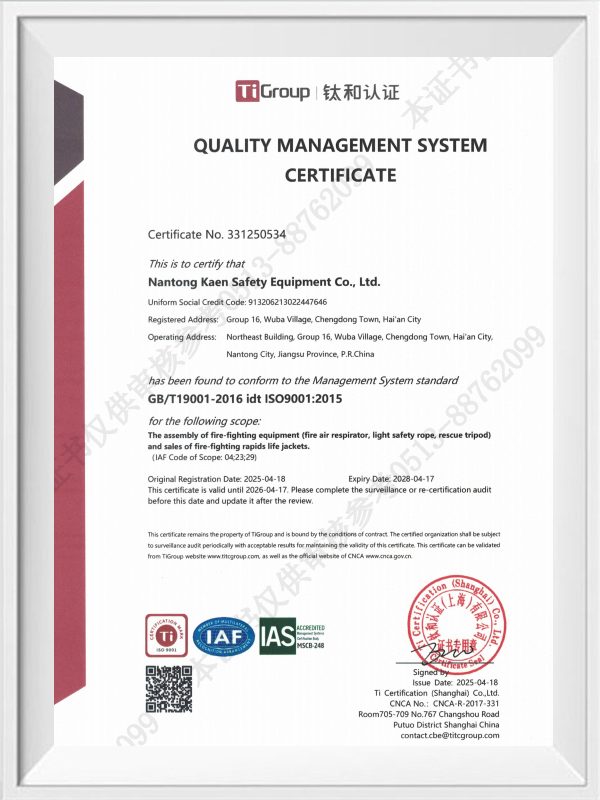
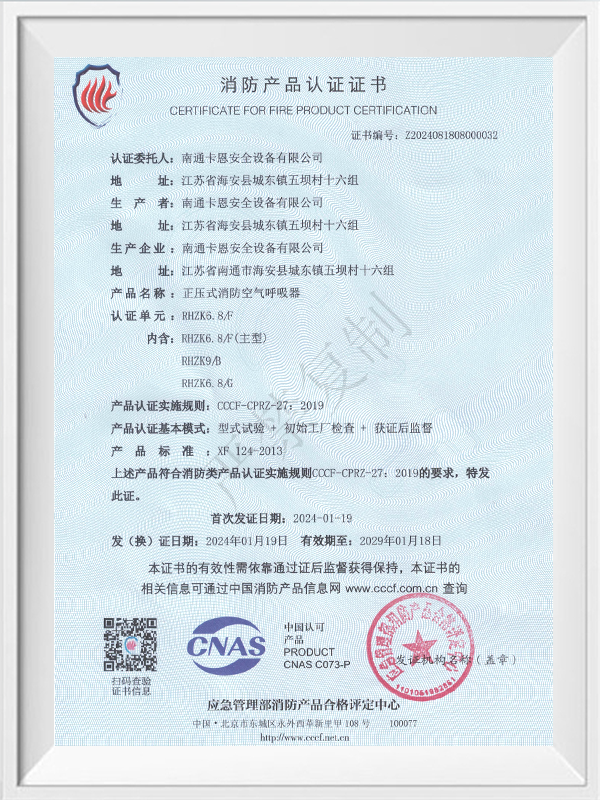
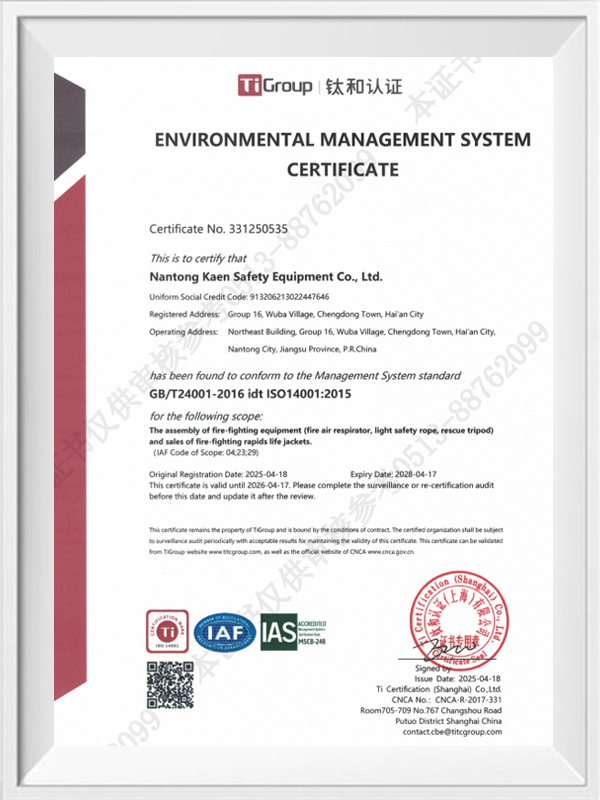
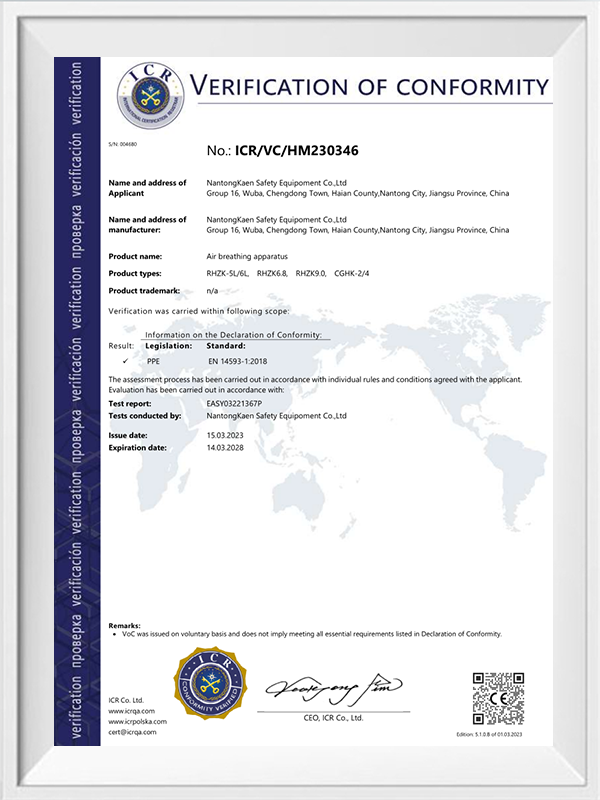
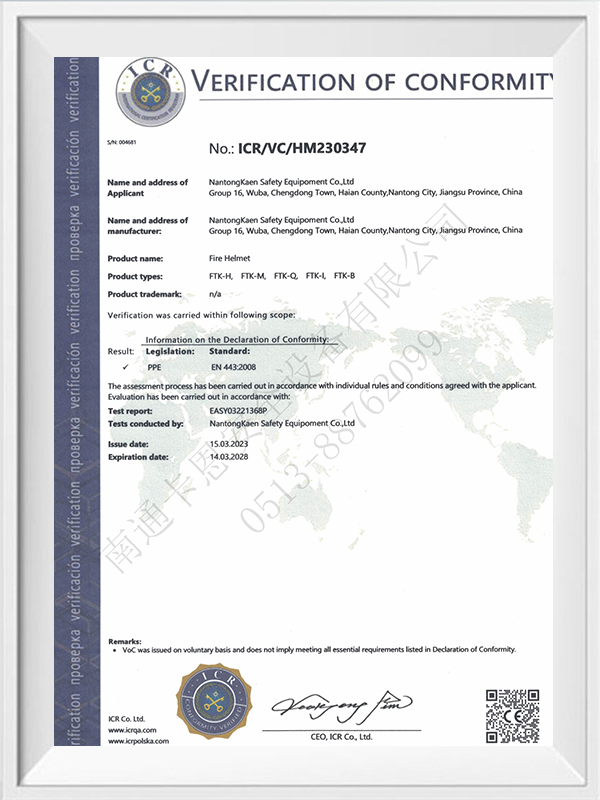
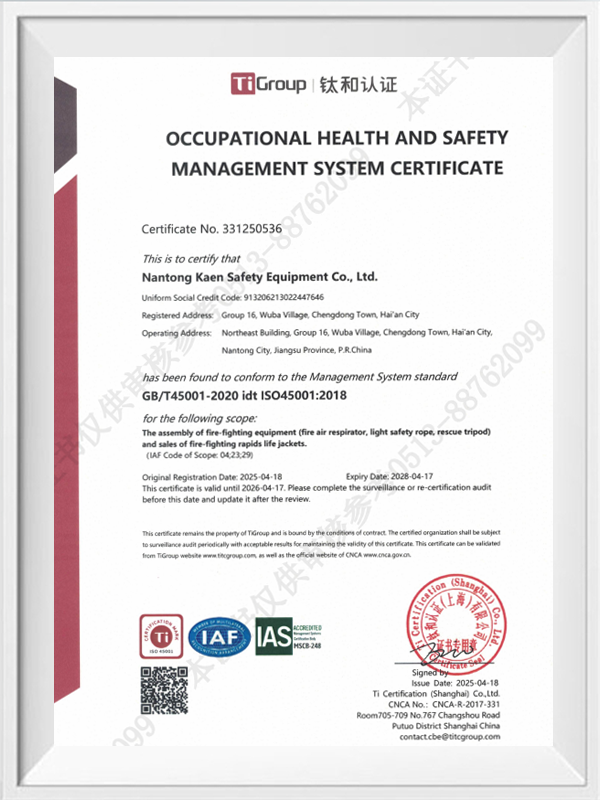
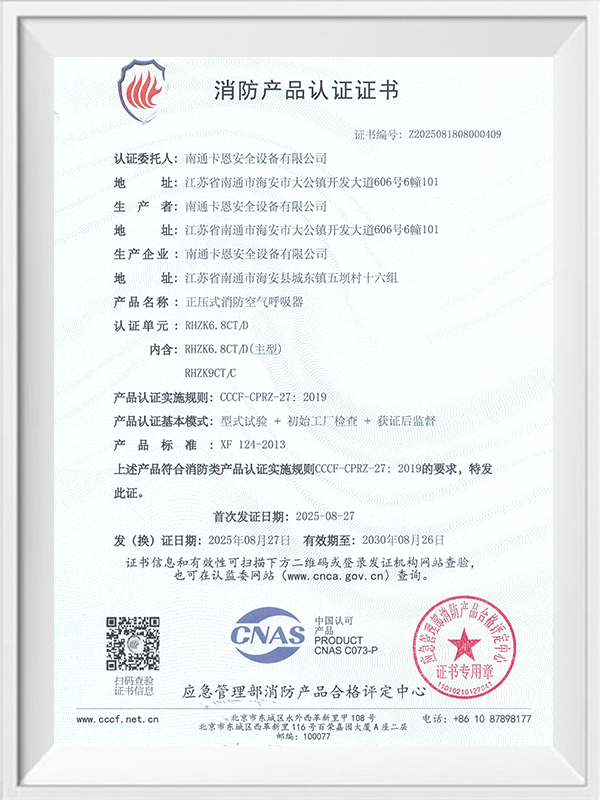
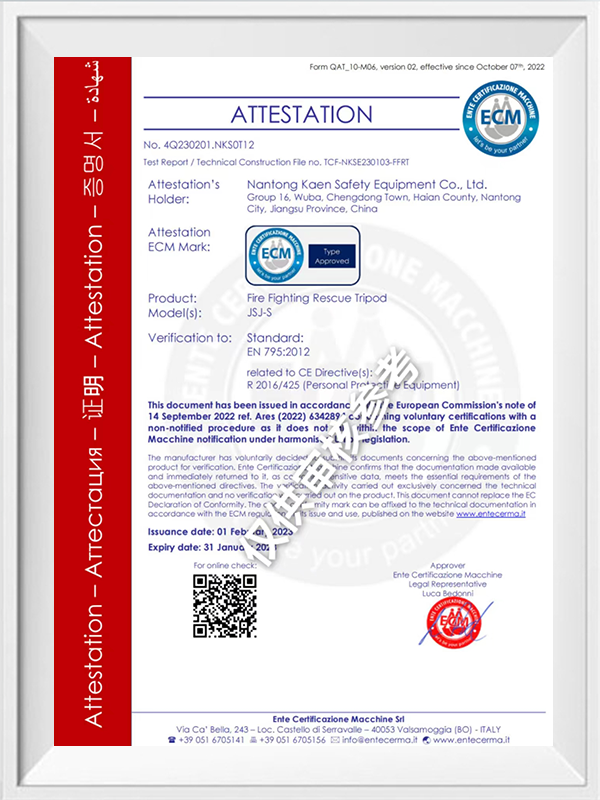
Nantong Kaen Safety Equipment Co., Ltd. is a China
Line Thrower Manufacturer and OEM Line Thrower Company
. It is located in Haian, a renowned county in Jiangsu Province, and situated within the National Economic Development Zone of Haian, Jiangsu, with convenient transportation and well-developed logistics networks.
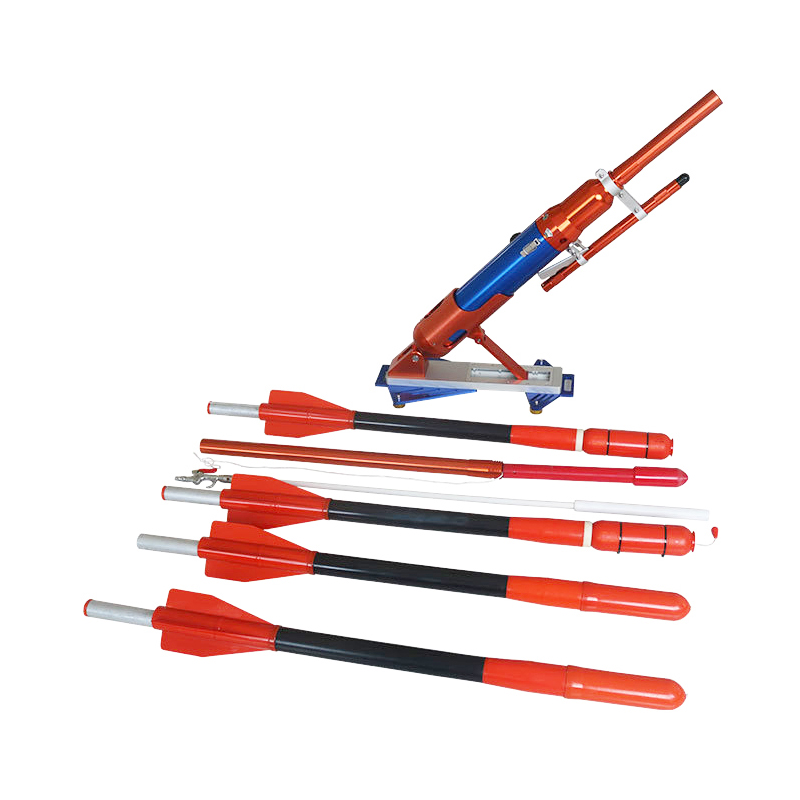
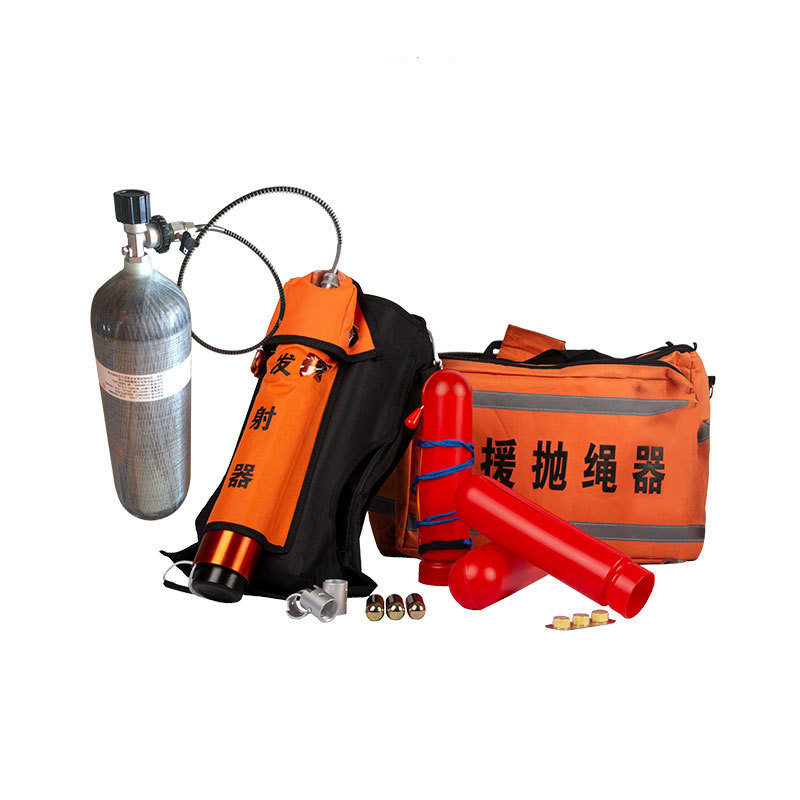
The PTQ8.5-Y230/T210 long-range rescue thrower is a pneumatic, amphibious, long-range rescue device powered by compressed air. It operates without open flame or sparks, making it suitable for flammabl...
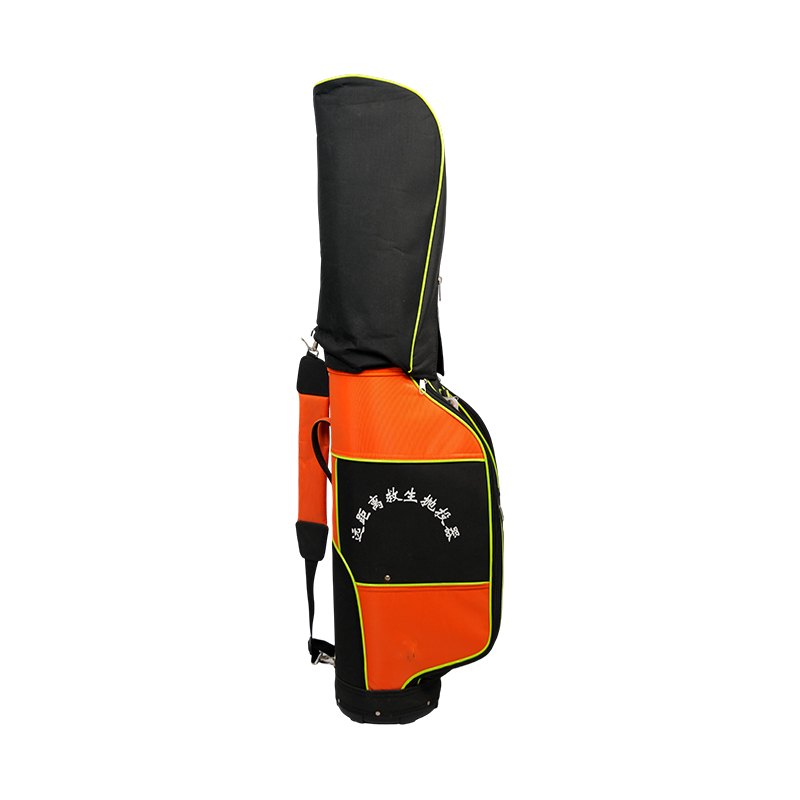
The PTQ20-Y100S70 is a Korean-style lifesaving throwing device that relies on high-pressure compressed air to deliver rescue supplies over long distances. The complete set includes a launch main unit,...
The PTQ8.5-Y350S250Q110 is a long-distance lifesaving throwing device that meets the GB/T 27906-2011 standard and has passed authoritative quality inspections. It offers three interchangeable throwing...
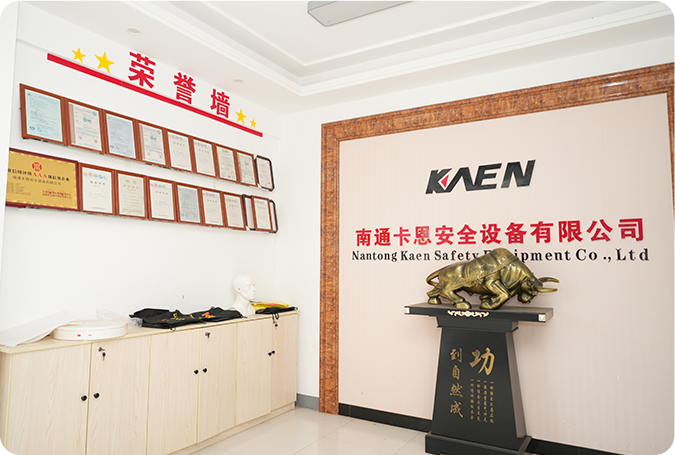
Nantong Kaen Safety Equipment Co., Ltd. is a professional enterprise specializing in the production and sales of fire safety protection equipment. It is located in Haian, a renowned county in Jiangsu Province, and situated within the National Economic Development Zone of Haian, Jiangsu, with convenient transportation and well-developed logistics networks.
Covering a floor area of 5,000 square meters, our company is equipped with modern and advanced production equipment and a team of professional management personnel. We have obtained the ISO9001 International Quality Management System Certification, and our products have passed the CE, CCCF, and other relevant certifications. Endowed with strong technical strength, we now have 36 technical personnel, including 5 senior engineers and 8 engineers. Our robust technical capabilities provide a solid guarantee for product after-sales services. However, the existing safety product service sector is still far from fully addressing people's demands for fire protection, safety,y and occupational health in work and daily life.
As one of the leading manufacturers in the fire protection industry, Nantong Kaen Safety Equipment Co., Ltd. is a Line Thrower Manufacturer and OEM Line Thrower Company, specializes in the R&D, production and sales of a full range of products, including air breathing apparatus series, fire helmet series, fall protection series (rescue tripods, safety ropes), hydraulic breaking and dismantling tool sets, personal protective equipment and other special protection equipment and facilities.
Our products are widely applied in the fire protection, metallurgy, chemical industry, military, police, and other public safety sectors. We provide customers with 24/7 uninterrupted services and always adhere to the three core principles: the most favorable price, superior quality,y and excellent service.
We are dedicated to providing first-class fire safety equipment and high-quality after-sales services for customers at home and abroad, and we look forward to cooperating with people from all walks of life.
We know we must go all out!
Kaen is your safety guardian, and Kaen will be with you forever!
A worker at the bottom of a manhole collapses. The entry team has a tripod, a winch, and a full-body harness. But if that harness has only a back D-ring, the retrieval line can lift the worker at an ...
A paint shop supervisor we worked with used to order disposable masks by the case. Then the primer changed to a solvent based product, odour breakthrough became a daily complaint, and the real proble...
A supervisor pulls a glove off at the end of a shift and finds a small puncture near the base of the thumb. The glove carried an ANSI puncture level 4 marking. The wire still went through. Nothing pr...
A technician on a metal finishing line pulls on a thin nitrile glove that shrugs off the degreasing tank and splits on the first sharp flange. On the next shift a glass handler wears an aramid cut gl...
A maintenance technician walks along a 14-meter loading platform edge, clipping a lanyard to a steel cable overhead. The cable runs between two anchor points and passes through intermediate brackets....
A Line Thrower is a launching device that propels a lightweight rescue line across water or open distance well beyond the range a person can achieve by hand, using compressed air, a spring mechanism, or a similar launch system to send a weighted line head toward a victim or vessel. This extended range is the defining advantage over a manual throw bag: while a trained rescuer can typically place a hand-thrown line accurately within roughly 20 to 25 meters, a line thrower can reach victims, boats, or structures at distances several times that, which matters significantly in open water incidents, ship-to-ship rescue, or situations where the victim is too far from shore for any manual technique to work.
The direct takeaway for procurement and safety teams is that line thrower effectiveness depends on measurable factors: launch distance, accuracy consistency, reload speed, and reliability across varying wind and weather conditions. This article walks through measured launch performance data, distance trends, and structural comparisons to give a clear, practical basis for selecting and training with this equipment category.
Core Performance Metrics Across Launch Configurations
When evaluating a line thrower, five metrics matter most: maximum launch distance, accuracy consistency, reload speed, wind resistance, and portability for field carry. The horizontal bar chart below scores two common configurations against these metrics on a 0-100 index built from typical field performance ranges: a compact handheld line thrower and a larger mounted or vessel-based unit. The handheld configuration scores highest on portability and reload speed, since it can be carried and operated by a single rescuer without additional setup, while the mounted unit scores highest on maximum launch distance and wind resistance, reflecting its larger propulsion charge and more stable firing platform.
This index-based comparison confirms that no single configuration dominates every metric, which is why the choice between a handheld and mounted line thrower should be driven by the specific rescue setting: a single rescuer on foot benefits most from portability and quick reload, while a vessel-based team operating over open water benefits more from maximum distance and stability in windy conditions.
Launch Distance Behavior Across Propulsion Charge Levels
A key operational factor for a line thrower is how launch distance scales with the propulsion charge used to fire the line head. The line chart below tracks maximum effective distance in meters across five charge levels, from a lower setting suited for close-range precision up to a maximum setting for extended range. Distance increases steadily as charge level rises, but the relationship is not perfectly linear, since higher charge levels also introduce more variability in landing point due to increased velocity and reduced flight-time control. This kind of charge-to-distance data helps rescue teams select the appropriate setting for a given situation rather than defaulting to maximum power for every throw.
Launch distance increases from roughly 28 meters at Level 1 charge to about 105 meters at Level 5 charge, giving rescue teams a wide practical range to select from depending on how far the victim or vessel is positioned. This data underscores why training on multiple charge settings matters, since choosing an unnecessarily high charge for a closer target can reduce accuracy and control over the line's landing point.
Where Line Throwers Are Commonly Deployed
The application spread of a line thrower reflects the range of long-distance rescue scenarios where a manual throw bag simply cannot reach. The vertical bar chart below shows a representative usage breakdown across common categories, based on aggregated field usage patterns. Ship-to-ship and vessel rescue leads the distribution, followed by open water search and rescue, harbor and port safety operations, and flood response across wide waterways.
Ship-to-ship and vessel rescue accounts for roughly 34% of typical deployment, reflecting the practical need to establish a line connection across distances a hand throw cannot cover safely. Open water search operations follow closely, since victims located well offshore often require the extended reach only a line thrower can reliably provide.
Line Thrower Versus Manual Throw Bag
A radar chart helps visualize the trade-off between a line thrower and a manual throw bag across multiple dimensions simultaneously. The chart below compares both across maximum distance, accuracy at close range, equipment simplicity, reload speed, and physical effort required from the rescuer. The line thrower extends much further on maximum distance, while the manual throw bag extends further on close-range accuracy, equipment simplicity, and lower physical effort, since it requires no mechanical launch system to operate or maintain.
Neither shape covers every dimension, reinforcing why many water rescue teams carry both tools rather than relying on one exclusively. A manual throw bag remains the faster, simpler option for close-range rescues, while a line thrower fills the gap for distances well beyond what a hand throw can reliably reach.
Practical Selection and Training Guidance
Choosing the right line thrower configuration starts with matching launch distance capability and portability to the typical rescue distances and deployment settings a team is likely to encounter. The table below summarizes practical guidance across common scenarios.
Scenario-Based Selection Reference
Table 1: Practical guidance for line thrower selection by scenario
Scenario
Suitable Configuration
Reason
Single-rescuer shore response
Handheld Line Thrower
Portable, quick to reload
Ship-to-ship or vessel rescue
Mounted Line Thrower
Maximum distance and wind stability
Victim close to shore
Manual Throw Bag
Simpler, faster for short range
Harbor and port safety standby
Mounted Line Thrower
Ready reach across wide berths
Before relying on a line thrower in the field, a few additional checks help support safe and reliable use:
Confirm the propulsion charge or air source is fully ready before deployment.
Inspect the line for tangles, fraying, or reduced buoyancy before each use.
Practice at multiple charge levels to build familiarity with distance and accuracy trade-offs.
Account for wind direction and speed when selecting launch angle and charge level.
Store and maintain the launch mechanism according to manufacturer guidance to ensure reliable firing.
The predictable distance curve discussed earlier depends on consistent manufacturing of the launch mechanism, line spool, and propulsion charge system inside a line thrower. Variation in charge calibration or spool tension can shift both launch distance and accuracy consistency, which is why tight process control matters throughout production. Automated assembly and in-process launch testing help keep the equipment performing within tight tolerances across production batches, supporting the reliability data referenced throughout this article.
Standard quality checkpoints such as launch distance verification, spool tension testing, and mechanism reliability checks support the performance trends shown earlier. For safety officers sourcing line throwers at scale, confirming these quality checkpoints with a supplier is often as valuable as reviewing published specifications alone.
About Nantong Kaen Safety Equipment Co., Ltd.
Nantong Kaen Safety Equipment Co., Ltd. is a professional enterprise engaged in the production and sales of fire safety protection equipment, including line throwers used across ship-to-ship, open water, and harbor rescue applications. The company is located in Haian, a renowned county in Jiangsu Province, and is situated within the National Economic Development Zone of Haian, Jiangsu, offering convenient transportation and well-developed logistics support for both domestic and international customers.
Drawing on its location within a well-connected industrial zone, the company focuses on producing reliable safety equipment while maintaining efficient logistics that support timely delivery. This combination of manufacturing focus and logistical positioning allows Nantong Kaen Safety Equipment Co., Ltd. to serve fire departments and water rescue organizations seeking dependable line thrower solutions for long-range rescue operations.
Frequently Asked Questions
Q1: How much farther can a line thrower reach compared to a manual throw bag?
A1: While a hand-thrown line typically reaches around 20 to 25 meters, a line thrower can extend that range several times further depending on the charge level and configuration used.
Q2: Does increasing the charge level always improve rescue outcomes?
A2: Not necessarily; higher charge levels extend distance but can reduce landing accuracy, so selecting the appropriate setting for the actual target distance matters more than defaulting to maximum power.
Q3: When is a mounted line thrower preferable to a handheld unit?
A3: A mounted unit tends to work best for vessel-based operations requiring maximum distance and stability, while a handheld unit suits a single rescuer needing portability and quick reload.
Q4: Should a rescue team carry both a line thrower and a manual throw bag?
A4: Many teams do, since a throw bag remains faster and simpler for close-range rescues while a line thrower covers distances beyond what a hand throw can reliably achieve.
Q5: What manufacturing factors most affect line thrower reliability?
A5: Launch mechanism precision, line spool tension consistency, and propulsion charge calibration are key factors, supported by process checks such as launch distance verification and mechanism reliability testing during production.


 English
 Español
 中文简体
中文简体